
FLEX-SHELL CORE PAVILION ARCHITECTURE
Flex-Shell Architecture
Durability and Natural Form
Flex-Shell Architecture is a building approach based on a simple idea:
structures should work with natural forces, not against them.
Instead of relying on mass, rigid framing, and layered materials, Flex-Shell systems use continuous, curved fluid-form shell forms that carry loads through shape and flow. These structures are designed to be strong, efficient, and long-lasting, using less material while achieving a higher level of resilience.
At the heart of the system is a high-performance composite mortar formed into thin, integrated shells. Rather than treating the material as something that must be maximized for density alone, the system introduces a controlled microcellular structure—tiny distributed voids that allow the material to absorb stress, accommodate movement, and resist long-term damage. This creates a structure that is not only strong, but also more forgiving under real-world conditions such as temperature change, moisture, and impact.
The result is a building system that behaves more like a natural structure—capable of distributing forces, resisting cracking, and adapting to its environment over time.
Flex-Shell Architecture is also about how structures are made. The process emphasizes accessible methods and practical techniques that can be implemented without highly specialized industrial systems. This opens the possibility for individuals and small teams to build durable, high-quality structures using a deeper understanding of material behavior rather than relying solely on complex supply chains.
Beyond performance, Flex-Shell Architecture reflects a broader shift in how we think about building. A home is not just a structure—it can be a long-term, resilient base for living, capable of integrating water systems, food production, and environmental control into a cohesive whole. When designed thoughtfully, these structures become part of the land rather than something imposed upon it.
This approach supports a model of living that is more local, more self-reliant, and more connected—where homes and small communities function as productive, interdependent systems rather than isolated units. It is not a return to the past, but a step toward a more balanced way of building and living, where durability, efficiency, and ecological integration are aligned.
Flex-Shell Architecture is an evolving system—grounded in material science, informed by natural principles, and driven by the belief that better structures can support a better way of life.
THE FRAME MATERIAL – This is a fast method that first uses a light, hardware-store-accessible grid-wire metal called 6″ x 6″-10 gauge Welded Wire Remesh fabric that is best purchased in 8′ x 20′ mats. Each mat is first cut into 7 – 2′ x 8′ sheets and 3 – 0.5′ x 8′ single grid ribbons and trimmed to have smooth edges.

BLENDED CURVILINEAR TRUSSES – The 2′ x 8′ sheets are then cut into 4- 2′ x 1.5′ to be made into the space blocks. The 3 – 2′ x 1.5′ grid flats are folded into wire frame spacer blocks. Other sheets are given one fold to reinforce the top cord and one side of the truss. The side reinforcing is cut so it can follow the exact curve of the truss while providing reinforcing to make the block wire truss solid. This method allows the exact curve to be revealed by blending two connection points and then that curve is locked as the side and top reinforcing is secured with pneumatic c ring clips.
Truss Configuration for Accurate Curves
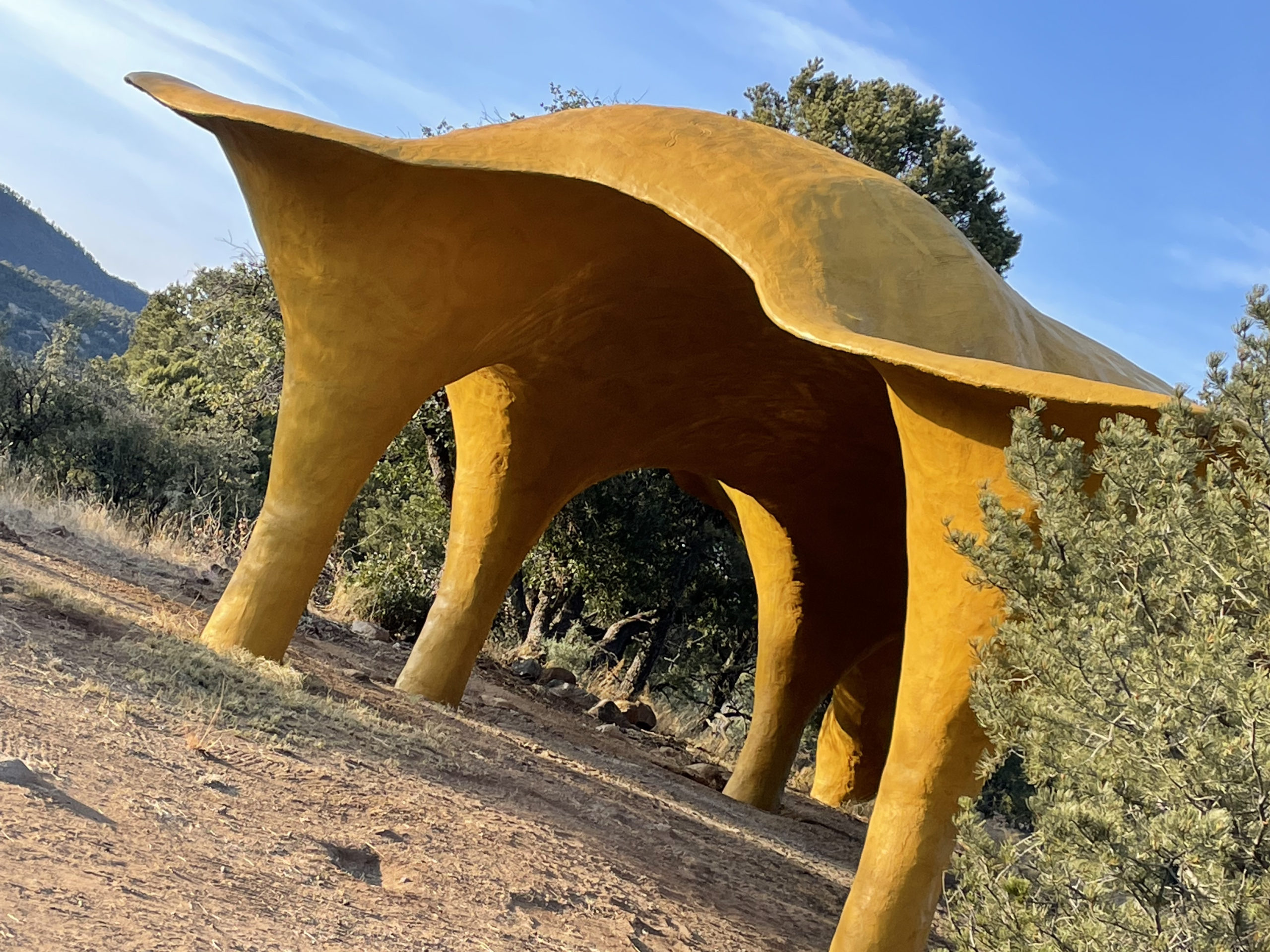
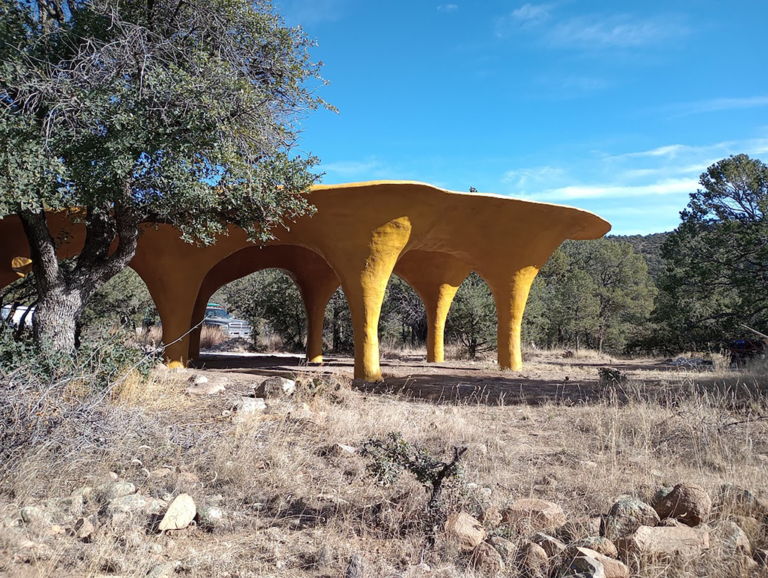
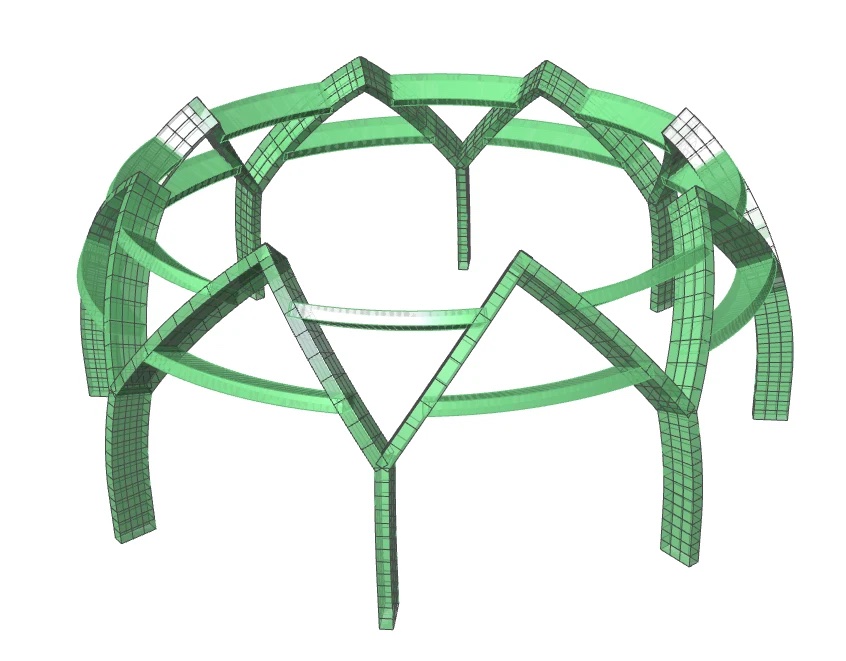
Each cylindrical column contains a central truss frame that establishes the primary curvature of the structure. This frame curves inward along an approximate 15.5-foot radius, beginning about 2 feet above finished floor height. This offset maintains head and shoulder clearance around the funnel-shaped columns and allows standard door openings to fit between the finished floor and the entry arch formed between adjacent columns.
At approximately 4.5 feet above finished floor height, the curved truss branches into two members, forming a “Y” configuration. These branching frames extend outward and upward while gradually curving inward to meet adjoining “Y” frames from neighboring columns. This region—where the column transitions into the roof structure—contains the critical geometry of the system.
Within this transition zone, the structure shifts from the tighter 15.5-foot column radius to the broader, shallow curvature of the main elliptical dome. By resolving this change in curvature within the branching “Y” framework, the system accommodates multiple radii without introducing abrupt transitions or stress concentrations. This approach allows complex curvature to be formed using relatively simple components, conserving material while maintaining structural stability.
The interconnected “Y” frames continue inward and intersect along the perimeter of the building, defining the overall plan geometry. While an elliptical layout is typical, the system is adaptable and can accommodate a range of configurations, including elongated, tapered, or angular layouts that respond to terrain and functional requirements.
The resulting zig-zag pattern formed by the intersecting “Y” frames is reinforced with horizontal trusses positioned above the column line and below the points where adjacent branches connect. This creates a continuous series of opposing triangular units, providing a stable and efficient load-distribution framework for the dome structure above.
This triangulated transition frame supports the central roof shell and extends outward to carry the perimeter awning, which functions as a single-shell extension of the primary structure. Together, these elements form a continuous, integrated system that efficiently transfers loads from the roof through the columns and into the foundation.
Structural Geometry and Shell Formation
The roof structure is formed using a triangulated space-frame lattice composed of curved, parallel-chord trusses. Unlike rigid prefabricated trusses, these members use flexible chords that allow controlled shaping during assembly. Internal wire-frame spacer blocks act as shear connectors, maintaining chord separation while enabling in-situ adjustment of curvature. This allows the geometry to be tuned during construction rather than fixed in advance.
The trusses are arranged in a multi-axial triangular pattern. By varying segment lengths and connection angles, the system develops Gaussian curvature (double curvature), allowing loads to be carried primarily through membrane action—tension and compression—rather than bending. This shift from bending-dominated behavior to membrane action is key to achieving high structural efficiency with minimal material.
The Blended Monocoque
The integration of funnel-shaped columns, a curled-edge awning, and a shallow elliptical dome (or “turtle shell” geometry) is not aesthetic alone—it is structural. These forms combine to create a continuous synclastic surface optimized for load distribution.
This curvilinear continuity is achieved by blending shallow and tight radii, avoiding abrupt transitions that would otherwise create stress concentrations. The structure transitions through distinct stages as it is assembled:
First, the truss network forms a triangulated space frame that establishes geometry and distributes loads.
As surface reinforcement is applied, the system begins to function as a curved structural sandwich, where the truss network acts as a core separating the top and bottom reinforcing layers.
Once the composite shell is applied and bonded, the system transitions into a monocoque structure. In this state, the trusses function as an internal web, while the composite skins act as structural flanges. The result is a continuous shell that provides lateral stiffness and distributes loads across the entire surface rather than through discrete members.
This transformation—from frame, to sandwich, to monocoque—enables the structure to behave as a single, integrated unit, combining strength, efficiency, and resilience.
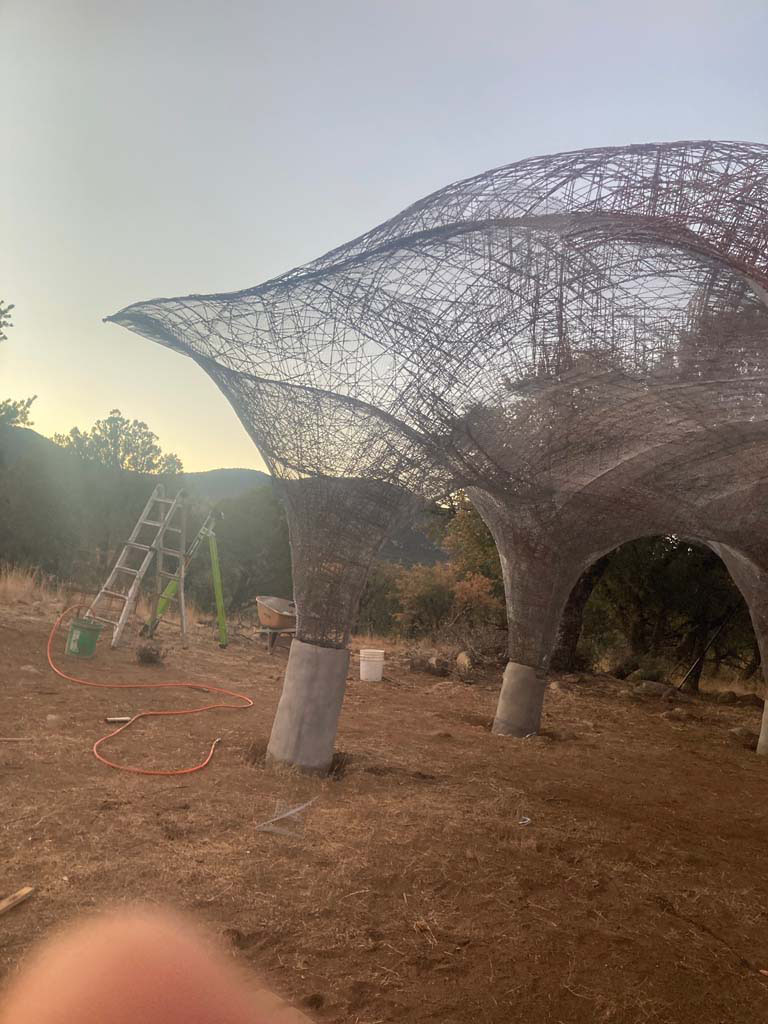
THE LATH SURFACE-SHELL FABRIC – A surface skin of metal fabric is also firmly attached to the fluidly shaped curvilinear frame and funnel columns using the same hogring gun. The 3.4 gauge, 3.4 lbs per yard, of expanded metal plaster lath is securely attached by slicing a tiny hole with snips where attachments are made while making sure the edges of the sheets are tight in small. The full sheets are 8’2″ x 2’3″ but those large sheets are cut in half or in thirds to attach to better control the desired overlap and not accidentally leave small gaps.
This frame provides ideal support and reinforcing for the thin curving surface shell. This approach enables a thinner, stronger to be properly reinforced. This conserves materials and labor. Also, slowly, using only one laborer, without structural consequences for cold joints. The frame makes the whole design easier to execute and more accessible to inexperienced builders.

THE SURFACE SHELL MATERIAL – The surface shells are based in a small-batch cutting edge reactive powder composite design, mixing method and hand application techniques that ensures proper execution of durable high-strength and self-healing thin shells. The surface shell material continues to gain strength and is enhanced with closed spherical micro cell aeration for resistance to chemical expansion damage and impacts. The high-strength self-healing shell material can be mixed in a small, low-cost mixer, if the mixing sequence is carefully followed. It is made in small batches that are less than 6 gallons to ensure consistency and the ability of one laborer to work alone, when needed. The shell material is blend of ultra refined flyash(STAR M3), Silica Fume (Eucon MSA), Fine sand (quartzite sand blasting sand 20-80 from Espey Silica Sand) regular ASTM C-140 mortar sand, Portland Cement, PVA RESC-15 Fibers, FortaFerro fibers, Plastol 5000 high-solids super plastisizer/water reducer and water.
SHELL APPLICATION TECHNIQUE – The reactive powder render (plaster) is hand-applied surface shells. It must be applied in small tiles, roughly between 3′ x 2.5′ and 2′ x 1.5′. A thin first layer is pressed into the lath fabric. This is called the adhesion layer. While it is still very fresh and wet, a thickening layer is applied. This layer is left fairly rough, but with a proper average thickness between 1/2″ to 3/4″. The rough wet tile area is lightly and quickly brushed with the acrylic surface glaze. This softens the upper layer so it can be smoothed with light passes of the clean damp trowel. Once the surface is smoothed and a 45 degree angle is smoothed on the exposed edges and the upper surface is still very soft, a clean acrylic-dampened mortar scratch rake is used in light passes to leave a grooved finish for the connecting edges and surface for a final coat that will come after this base coat cures. You can use stains or 100 % acrylic paint on the surface or a combination for color. Finishing with a basic clear arcylic seal is best because the surface lacks porosity that would allow other types of water seals to work and the acrylic seal will create a durable bond. The seal is likely not necessary but will allow time for any cracks to heal up on their own and if additional coats are desired, you don’t have to scrape away the seal because it will help bond.

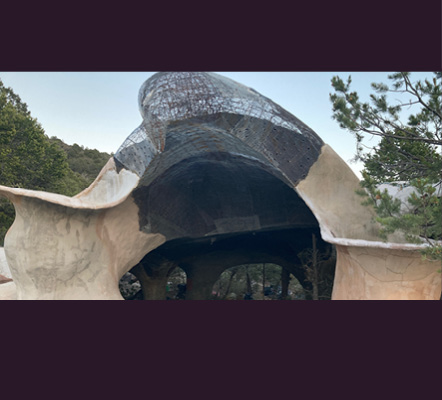
THE INTEGRATED FOUNDATION DESIGN – Building with the flow minimizes disruption in the building environment. This is achieved by doing columns first in the more stable undisturbed ground, followed by the use of the framing and shell material for curvilinear retaining walls that protect the columns from erosion damage while terracing in the main flat pad, other flat pads and access ramps or paths that channel runoff into water-storing gardens to reverse erosion, build soils and minimize the use of heavy materials brought in.
This Core Monolithic form is made sturdy by the framing methods ability to accurately blend and balance curvilinear shapes into a singular curvilinear form. This core form achieves a high level of stability by distributing deformation strains over the larger whole of the building. By regarding this Core Monolith Flex-Shell Pavilion as a stand-alone foundational building integrated into the natural drainage, long-term stability and the conservation of high-energy material is achieved.
The Core Pavilion starts as reinforced cylindrical column foundation points. If the column is attaching to soil and not sand, stone, mud, or on water, which require different column foundation designs, the column frame is simply dropped into the proper sized hole, anchored to a ’T’ post driven as deep as possible into the bottom of the hole at a steep inward angle to hold the metal reinforcing base off the ground a bit and help prevent the heavy building from being lifted in high-winds or tornado. The composite is poured in to the proper depth and the column base is plastered as a cylinder to a point that is 2 feet above finished floor height.
From there, these column bases supports the entire building frame and column frame. The columns flare upward, like a fountain or funnel-shaped mushrooms. Starting the curves at 2 feet above finished-floor height is guideline that helps proper head and shoulder clearance around the columns and enough clearance between columns for a standard door frame.
These flowing funnel shapes smoothly and accurately blend to curving forms above. The roof is an insulating curvilinear stress-skin, that may be a shallow turtle shell-like dome. That dome-like shape vary and can even be very shallow, somewhat flat on the top, depending upon the span. This is because of the deep, wire-block trusses create a sturdy stress-skin effect. That dome roof, still exerts an outward force like all domes, a stored energy tendency to flatten out, but that force is fully contained, or rigidified by the stress-skin effect, but also that force is balanced by a single-shell awning on the outside to give better support during extreme loading conditions, such as earthquakes and tornados.
The outer edges of the awning curls downward for overall stability in much the same way a paper plate is made more stable by the outer edge curling downward. This curled edge also rotates rapidly rising air back down so can function to repel wild fires from the entry walls below.
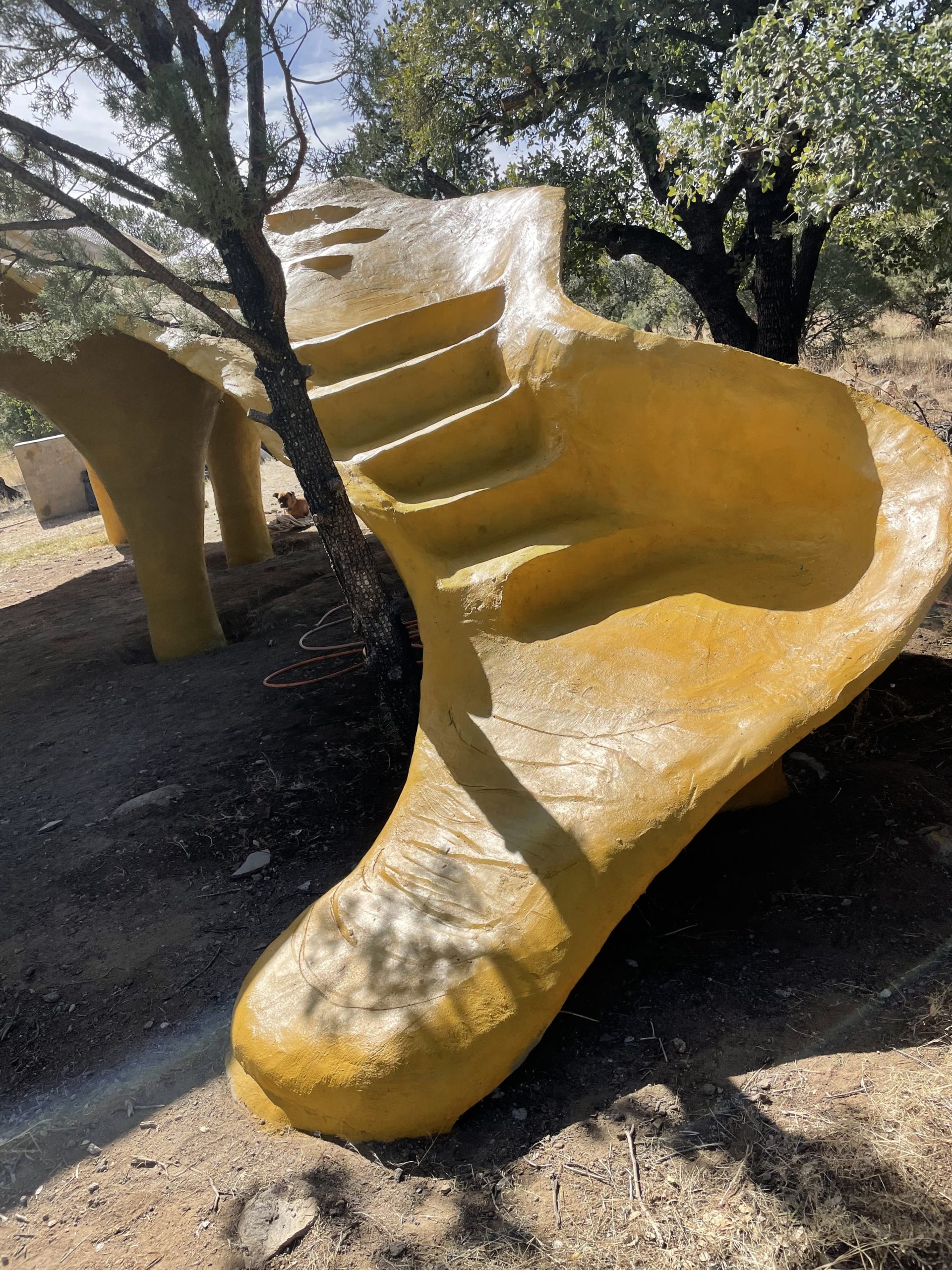
The awning, being the upper and outer part of the funnel columns, forms a single-shell bowl-like reservoir on the roof. Besides the awning shape balancing the forces in the dome it also shelters the entry walls built in later. Those entry walls are nestled into the curved archway and columns so they cannot fall inward or outward during an earthquake, and they are built upon the flat floor, so those walls are not required to be built in any specific or straight-line layout. They can be creative adaptations that bounce light and divide the rooms in unique ways, they can be built and rebuilt from changing perspectives overtime.
The entry walls have no mechanical bond to the archway or flat floor, only a chemical adhesion bond; they are plastered in to create a weather seal. This provides greater stability during earthquakes by allowing the walls and roof to move independently under extreme earthquake conditions, in the same way the center pole in a pagoda is allowed to move independently to help stabilize the building during an earthquake.
Material costs and labor are conserved and a very durable structure is achieved by focusing on those structural goals, focusing on long-term stability as a shape-guiding priority for the core of the building, which is properly supporting an insulating stress-skin shell roof with fluid-form columns and flexible, or flex-stable, curvilinear outer shells that balance the outward pushing force in the dome, while secondarily sheltering the eventual entry walls.
Additionally, this column approach and curvilinear shell method lowers the cost of the foundation and makes it possible to integrate the flat pads for the building environment into the drainage to reverse erosion and enhance the surrounding ecological diversity, by managing the runoff via a water-storing garden environment. Like the surrounding runoff gardens, the bowl shapes above the columns can function similarly to store and manage water below garden soil but in a more protected roof garden. This approach to core design first, allows the entry walls to be more creative and adaptable and also provides long-term stability that happens to encourage stewardship and legacy-durable productive estate.
PHILOSOPHY OF FLEX-SHELL CORE MONOLITH ARCHITECTURE
Flex-Shell Core Monolith Architecture is grounded in a simple but often overlooked principle:
a structure should arise from its relationship to natural forces, not be imposed against them.
The organic character of the finished form is not decorative. It emerges from the internal geometry of the system—the way forces move through the structure, how materials respond, and how the building engages with its environment. This creates a kind of dialogue between structure and condition, where form follows not just function, but relationship.
The principles of long-term stability, durability, and independent sustainability are not aesthetic choices or philosophical overlays. They are embedded in the structure itself. The building communicates these qualities because it is genuinely founded upon them.
This is similar to music. While expression varies infinitely, music resonates because it is grounded in underlying structure—proportion, rhythm, and harmonic relationship. These provide a stable framework that allows for adaptation and meaning. In the same way, the Core Monolith approach establishes a structural language based on durability, accessibility, and coherent geometry. The result is not only strength, but a sense of alignment—an architecture that supports not just survival, but continuity, adaptability, and the conditions for life to thrive.
This approach also challenges common assumptions about what is considered “natural” or “sustainable.” Organic form alone does not guarantee alignment with natural systems. Just as rectilinear construction can impose rigid abstractions, organic or alternative building methods can also become disconnected if they ignore durability, structural logic, or long-term consequences. In many cases, short-lived construction is presented as sustainable, supported more by aesthetic or philosophical framing than by actual performance over time.
Impermanence is a meaningful concept when understood as a condition of life, not as a justification for waste. There is a clear distinction between temporary structures—such as those needed in disaster response—and long-term shelter. Durable construction, when thoughtfully designed and responsibly executed, is not in conflict with natural principles. It is an expression of stewardship—of building in a way that respects both present needs and future generations.
Similarly, the replication of natural forms through computational or generative design, while often visually compelling, can become an abstraction when it prioritizes appearance over relationship. Capturing the image of nature is not the same as participating in its processes. Flex-Shell Architecture seeks to move beyond representation, toward integration—where structure, material, and environment function as a coherent system.
At its core, the Flex-Shell Core Monolith approach is about alignment:
between structure and force,
between material and purpose,
and between human habitation and the natural world.
.